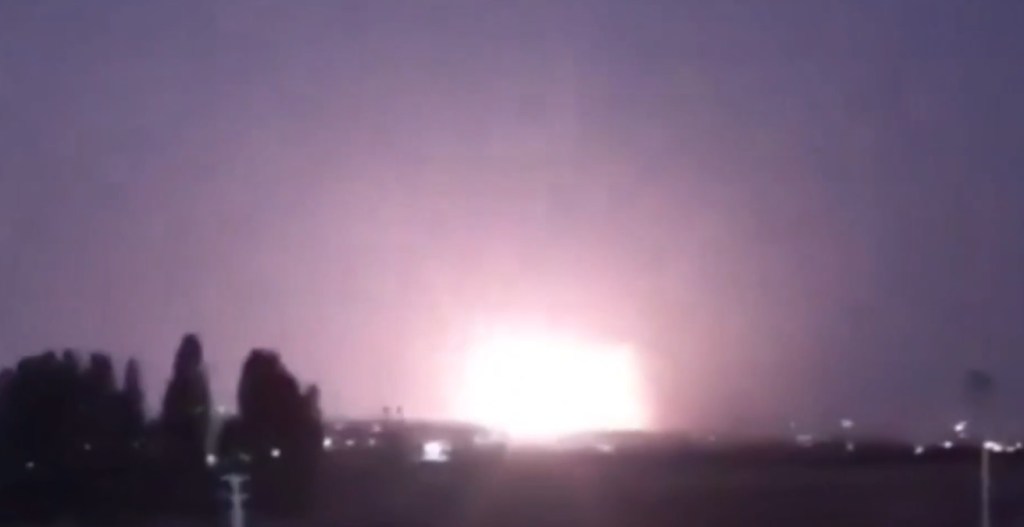
The United States has officially entered the Iran-Israel war. On Saturday, Donald Trump announced that the US bombed the three nuclear sites of Iran, including Fordow.
“A full payload of BOMBS was dropped on the primary site, Fordow. All planes are safely on their way home,” Trump said in his first post on his social media platform, Truth Social, after bombing the Iranian nuclear sites.
“Congratulations to our great American Warriors. There is not another military in the world that could have done this. NOW IS THE TIME FOR PEACE! Thank you for your attention to this matter,” he further stated.
The other two nuclear sites hit by the US are – Natanz and Esfahan.
Trump’s Oval Office Address:
While delivering an address after the attack, Trump said that the US planes “completed a very successful attack” on Iran’s three nuclear sites – Fordow, Natanz, and Esfahan.
“Iran’s key nuclear enrichment facilities have been completely and totally obliterated. The strikes were a spectacular military success,” the US president said in the Oval Office address.
Giving a stern warning to Iran, Trump said that there are many other targets that could be hit and Tehran’s future held either “peace or tragedy.”
“If they do not, future attacks will be far greater and a lot easier,” the US President stated.
“There will be either peace or there will be tragedy for Iran far greater than we have witnessed over the last eight days,” he added.
“But if peace does not come quickly, we will go after those other targets with precision, speed, and skill. Most of them can be taken out in a matter of minutes,” Trump warned Iran.
Israeli PM Benjamin Netanyahu Praised Trump:
Israeli Prime Minister Benjamin Netanyahu hailed Trump after the US bombings.
“Congratulations, President Trump. Your bold decision to target Iran’s nuclear facilities with the awesome and righteous might of the United States will change history,” the Israeli PM said in a video address.
“President Trump and I often say: ‘Peace through strength.’ First comes strength, then comes peace. And tonight, Donald Trump and the United States acted with a lot of strength,” Netanyahu added.
All About Fordow:
The construction of the Fordow facility started in 2006. It was carved about 80–90 m inside a mountain near Qom—far below ground to withstand airstrikes. The details about the Fordow facility were revealed in 2009 after the US and European intelligence exposure. Iran then informed the IAEA about this facility.
Also Read: What Is GBU-57 MOP? US Bunker Buster Bomb That Israel Needs To Destroy Iran’s Nuclear Sites
Initially, it was portrayed as a backup to Natanz for civilian enrichment purposes (5% U‑235). However, it was allegedly used to make nuclear weapons. The US used a bunker buster bomb – GBU 57 to destroy Fordow.
Activity Timeline of Fordow:
2009: Declared to IAEA; started declaring 5% UF₆ enrichment cascade.
2011: Began enriching up to 20% U‑235.
2015–2018: Under JCPOA, enrichment paused; used for research and isotope production with limited centrifuge operation.
2018–2022: U.S. exit from JCPOA led Iran to resume enrichment; output reached 60% U‑235.
2023: IAEA found uranium enriched to ~83.7%—close to weapons grade.
All About Natanz Nuclear Facility:
The Natanz nuclear facility is located near Natanz, in Isfahan Province, central Iran. The site is situated in a desert plateau about 250 km south of Tehran and surrounded by mountains—making it strategically remote and easier to defend.
The facility is composed of two halls buried under 8 meters of concrete and earth for protection against airstrikes. It is designed to house 50,000 centrifuges, although far fewer are operational at any time. Iran reportedly used IR-1 (first-generation) centrifuges and developed more advanced types like IR-2m, IR-4, and IR-6 at this facility. These machines enrich uranium hexafluoride (UF6) to increase concentrations of U-235, a fissile isotope.
All About Esfahan Nuclear Site:
Isfahan is located in central Iran. It is home to the country’s largest nuclear research complex, reported CNN.
According to the non-profit Nuclear Threat Initiative (NTI), this facility was built with support from China and opened in 1984. It is Iran’s largest nuclear R&D campus, active since 1984 with Chinese help. The facility hosts multiple small research reactors: MNSR, light-water, heavy-water, graphite, along with labs and zirconium production.
 Defence Stories
Leave a comment