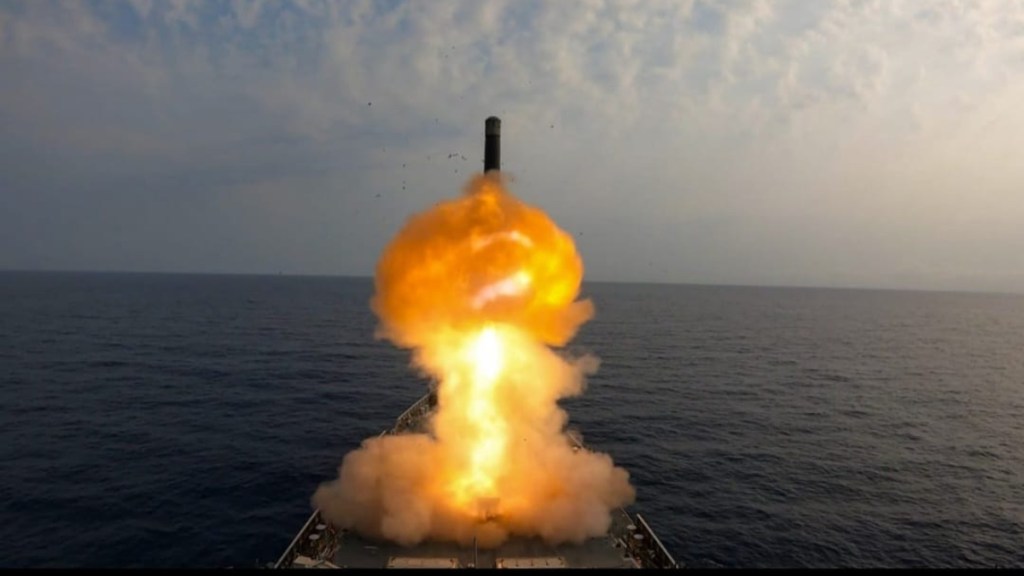
To counter China’s growing influence in the Indian Ocean Region (IOR), India is strengthening its naval capabilities by investing in major defence projects for the force, including the development of aircraft carriers, stealth frigates, destroyers, submarines, and other deadly weapons. Working in this direction, the Defence Research and Development Organisation (DRDO) is developing the K-6 missile, reported News18. According to reports, trials of this missile will begin soon.
The K-6 is a hypersonic submarine-launched ballistic missile (SLBM). With the induction of this missile, the attack capabilities of the Indian Navy will increase manifold. Possessing far greater capabilities than the BrahMos missile, the induction of the K-6 will place India in the league of major global powers such as the United States, Russia, China, France, and the United Kingdom.
The major strengths of this missile are its speed and range. The K-6 hypersonic missile reportedly has a speed of over Mach 7 and a range of approximately 8,000 kilometres.
The K-4 (3,500 km range) and K-5 (5,000 to 6,000 km range) SLBMs have already been inducted. The K-6 hypersonic missile and the Agni-5 Intercontinental Ballistic Missile (ICBM) will pose a significant threat to adversaries.
The K-6 SLBM is being developed at DRDO’s Advanced Naval Systems Laboratory in Hyderabad, according to a News18 report. The missile’s Multiple Independently Targetable Re-entry Vehicle (MIRV) capability makes it even more lethal.
Features of the K-6 Missile:
Type and Role
- Type: Submarine-launched hypersonic ballistic missile (SLBM)
- Role: Strategic nuclear delivery, second-strike capability
Range
- Estimated range: 8,000 kilometres
- Will significantly extend the reach of India’s sea-based deterrent beyond current K-series missiles (K-4 and K-5)
Speed
- Hypersonic velocity: Expected to exceed Mach 7
- Hypersonic speed makes it much harder to intercept compared to traditional ballistic missiles
Warhead
- Capable of carrying Multiple Independently Targetable Reentry Vehicles (MIRVs)
- Likely to carry 4 to 6 nuclear warheads
- Each warhead can target a different location
Launch Platform
- Designed for nuclear-powered ballistic missile submarines (SSBNs)
- Future Indian SSBNs with larger missile silos than the Arihant-class (such as the S-5 class) are likely candidates
Stealth and Survivability
- Sea-based deployment enhances stealth and survivability, ensuring a credible second-strike capability
- Hypersonic nature improves penetration capability against modern missile defense systems
Development Status
- According to reports, trials are set to begin soon.
- Timelines have not been officially disclosed.
Strategic Significance
- Strengthens India’s No First Use (NFU) doctrine through an assured retaliatory strike
- Enhances the credibility of India’s nuclear deterrent against adversaries with advanced missile defence systems
 Defence Stories
Leave a comment