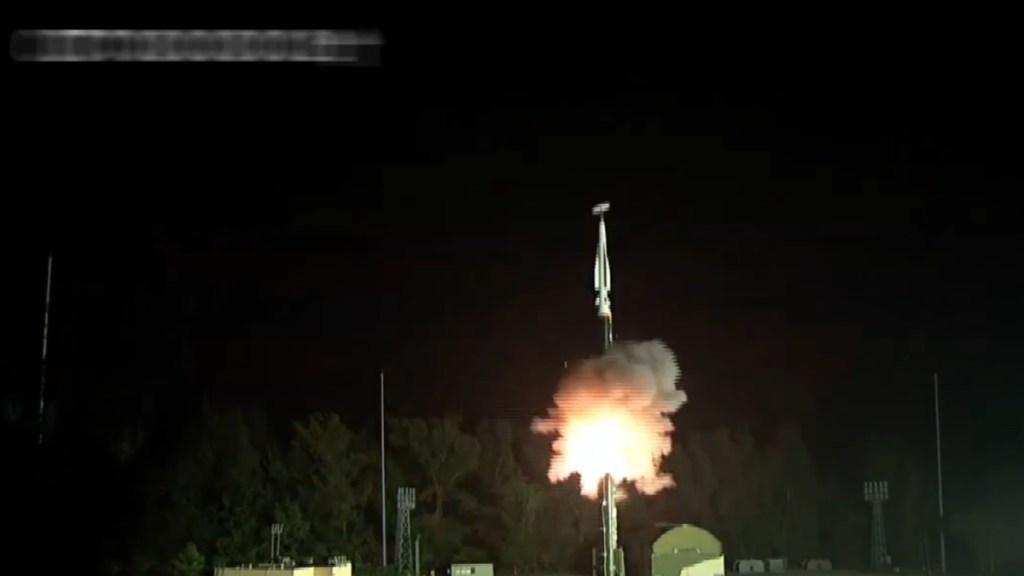
New Delhi: With the development of Project Vishnu in progress, India’s defence ecosystem is undergoing a significant overhaul. The project refers to a high-priority Indian defence program aimed at developing an advanced, highly manoeuvrable missile system. This missile — the Extended Trajectory–Long Duration Hypersonic Cruise Missile (ET-LDHCM) — will be developed by the Defence Research and Development Organisation (DRDO) using indigenous technology. With its ultra-high speeds, cutting-edge stealth capabilities, and adaptability across multiple platforms, Project Vishnu places India in the league of global leaders in hypersonic technology, alongside the U.S., China, and Russia.
Notably, the details of this project are still classified. As per the available information, this missile is designed to achieve speeds between Mach 8 and Mach 10. It is almost three times faster than India’s fastest operational missile, the BrahMos. The maximum speed of BrahMos is Mach 3. The missile is reportedly capable of penetrating deeply into enemy territory, with a range of 1,500 km, extendable to 2,500 km in a surface-to-surface configuration, reported Eurasian Times.
The ET-LDHCM can be launched from land, aerial, or maritime platforms, giving an edge to Indian defences by ensuring operational versatility.
The ET-LDHCM is reportedly powered by an indigenous scramjet engine. This engine utilises atmospheric oxygen for combustion, which improves fuel efficiency and supports sustained hypersonic flight.
The missile’s propulsion system empowers it to maintain speeds that far exceed the capabilities of conventional air defences while covering long distances—making it a powerful addition to India’s strategic arsenal.
Its airframe is expected to be constructed using heat-resistant materials designed to withstand temperatures of up to 2,000°C, generated by the extreme friction encountered during hypersonic flight, reported Eurasian Times. To enhance its operational longevity, it would also feature oxidation-resistant coatings, allowing it to endure harsh conditions such as seawater exposure and intense sunlight—making it well-suited for naval missions.
How Project Vishnu Can Be A Gamechanger For India?
The ET-LDHCM’s strength lies not just in its speed and range, but also in its advanced stealth features. By flying at low altitudes, it significantly reduces radar visibility. Its ability to perform evasive manoeuvres mid-flight further increases its chances of slipping past enemy defence systems.
Adding to its stealth capabilities is the plasma stealth effect, caused by ionised air at hypersonic speeds. This phenomenon absorbs radar waves, effectively reducing the missile’s radar cross-section and boosting its chances of a successful strike.
The missile is expected to carry payloads between 1,000 and 2,000 kilograms, including either conventional or nuclear warheads, providing India with the flexibility to use it for tactical missions or strategic deterrence.
Project Vishnu, named after the Hindu deity associated with power and preservation, embodies India’s ambitions to develop a next-generation hypersonic missile system capable of executing swift, accurate, and virtually unstoppable attacks.
This project builds on India’s earlier achievements in missile technology, such as the BrahMos (Mach 3), the Shaurya missile, and the Hypersonic Technology Demonstrator Vehicle (HSTDV). However, Project Vishnu is not merely an advancement—it marks a transformative leap forward.
The successful HSTDV trials demonstrated India’s capability to sustain hypersonic speeds above Mach 5 using an indigenously developed scramjet engine. A 1,000-second ground test of this engine was a major milestone, laying the technological foundation for the development of the ET-LDHCM.
Unlike conventional ballistic missiles, hypersonic cruise missiles like the ET-LDHCM merge blistering speeds with low-altitude flight paths and high manoeuvrability—making them extremely difficult to intercept using current air defence systems.
Looking ahead, the anticipated 2025 test of the ET-LDHCM will be a defining moment. Operational deployment of the missile and its variants will require continuous investment, exhaustive testing, and seamless integration with existing military infrastructure.
The Defence Research and Development Organisation (DRDO) will rely heavily on collaboration with Indian industry and academic institutions to resolve technical challenges—such as upscaling production and ensuring operational reliability across diverse combat scenarios.
Strategic Impact
Project Vishnu propels India into an elite group of nations possessing hypersonic capabilities. While the U.S., China, and Russia have poured significant resources into similar technologies with varying results, India’s homegrown approach stands out. By reducing its dependency on foreign technologies, the project bolsters India’s strategic independence.
As China’s hypersonic missile arsenal, including the DF-21D and DF-26, has raised concerns about regional power imbalances, the ET-LDHCM is likely to shift regional security dynamics. Similarly, Pakistan’s expanding missile programmes demand credible countermeasures. The ET-LDHCM’s ability to deliver fast, deep strikes gives India a sharper deterrent edge, enabling quick neutralisation of emerging threats.
 Defence Stories
Leave a comment