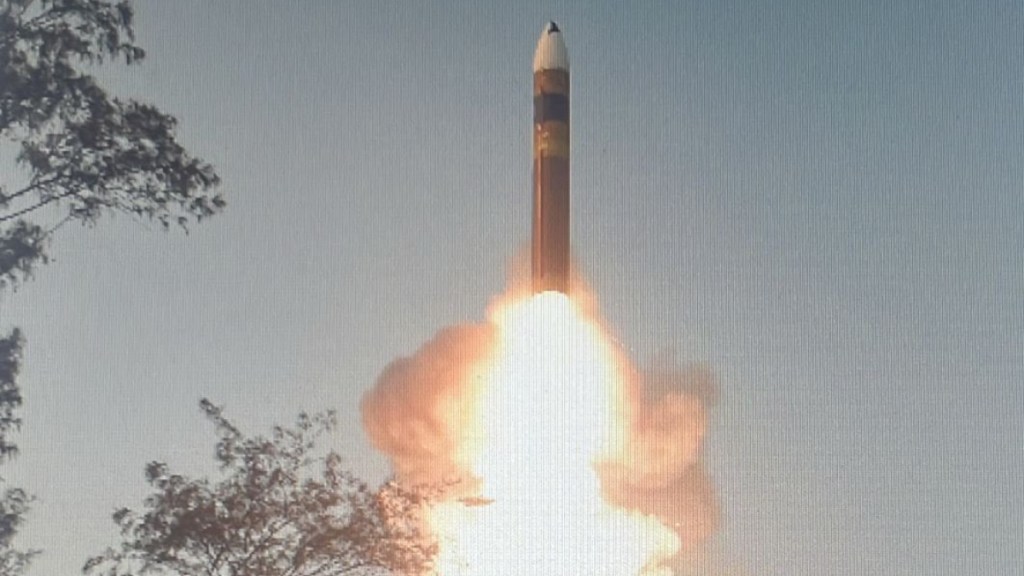
In a major boost to defence capabilities, India on Wednesday successfully test-fired the Intermediate-Range Ballistic Missile (IRBM) Agni-5 from the Integrated Test Range, Chandipur in Odisha. The missile, with a range of almost 5,000 km, can cover the entire continent of Asia.
“The launch validated all operational and technical parameters. It was carried out under the aegis of the Strategic Forces Command,” the Ministry of Defence said in a statement.
Last year in March, the Agni-5 was tested with multiple-warhead capability, or Multiple Independently Targetable Re-entry Vehicle (MIRV) technology, under ‘Mission Divyastra’.
It will take a few years for the Agni-5 missile to become fully operational. For the unversed, an MIRV payload allows a single missile to carry three to four nuclear warheads. These warheads are programmed to be released at different speeds and along different trajectories to strike multiple targets, which may be hundreds of kilometres apart.
Missiles in the Agni series (Agni-1 to Agni-5) have ranges from 350 km to over 5,000 km, and most have already been deployed.
Features of Agni-5 Missile:
- Type: Intercontinental Ballistic Missile (ICBM)
- Range: Over 5,000 km (potentially up to 8,000 km)
- Stages: Three-stage missile with solid fuel propulsion
- Launch System: Canister-based launch (road-mobile and rail-mobile)
- Accuracy: Very high, with CEP under 100 meters
- Guidance System:
- Inertial Navigation System (INS)
- Ring Laser Gyroscope
- Optionally supported by satellite navigation (GPS/IRNSS)
- Payload Capacity: Up to 1,500 kg
- Warhead Type:
- Capable of carrying nuclear or conventional warheads
- Future versions may carry MIRVs (Multiple Independently Targetable Reentry Vehicles)
- Stealth & Survivability:
- Stored in hermetically sealed canisters for rapid launch
- High mobility and survivability, ideal for second-strike capability
- Speed: Hypersonic — over Mach 20 during re-entry
- Developed By: DRDO (Defence Research and Development Organisation), India

 Defence Stories
Leave a comment