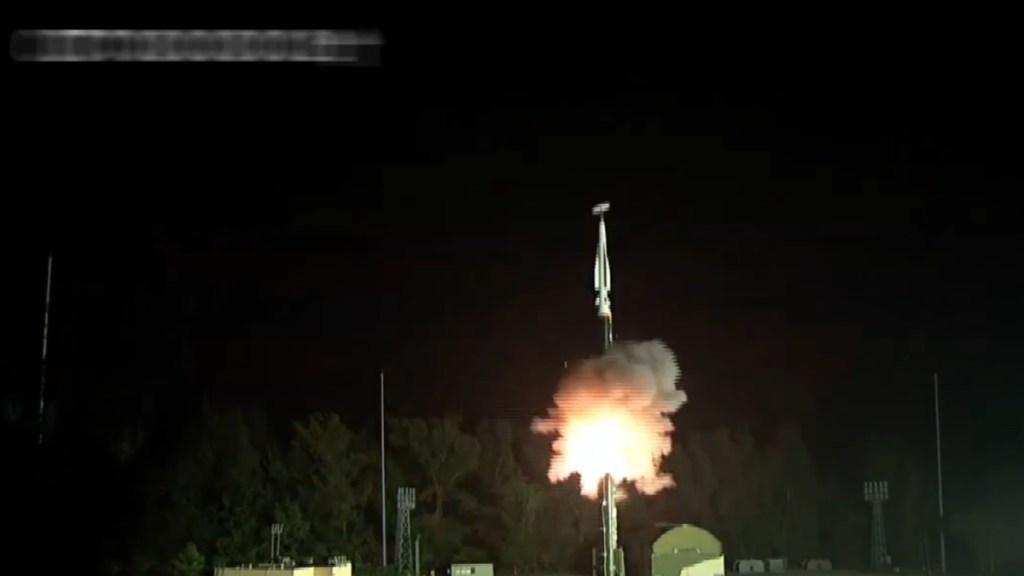
In a significant step towards strengthening the capabilities of the defence forces, India is reportedly working to develop the most advanced indigenously developed hypersonic missile. This missile — the Extended Trajectory–Long Duration Hypersonic Cruise Missile (ET-LDHCM) — will be developed using indigenous technology by the Defence Research and Development Organisation (DRDO). The project is codenamed ‘Vishnu’.
As per Dainik Jagran, ‘Project Vishnu’ is considered a gamechanger for the Indian defence forces. The missile will be capable of carrying out deep precision strikes with a top speed of Mach 8, nearly 11,000 kmph. With this missile, India will gain the capability to strike deep into the territories of not only Pakistan but also China.
So far, only three countries have hypersonic weapons technology. These countries are the United States, Russia, and China. The missile is designed to carry both nuclear and conventional warheads weighing between 1,000 and 2,000 kg over a range of approximately 1,500 km, reported Moneycontrol. As per sources, the missile will have evasive mid-flight manoeuvrability and velocity, which makes it difficult to intercept.
The ET-LDHCM is reportedly equipped with an advanced scramjet engine. This engine uses atmospheric oxygen for fuel combustion, due to which it can sustain hypersonic speeds for extended durations.
Also Read: Indigenous Rudram Missiles By DRDO To Boost India’s Strategic Air Power – Key Features
For the unversed, the DRDO has already conducted a successful 1,000-second ground test of the scramjet engine, reported Moneycontrol. The ET-LDHCM can fly at lower altitudes compared to traditional ballistic missiles and has the capability to make mid-course corrections. It is reportedly built with heat-resistant and oxidation-resistant materials, which can withstand temperatures of up to 2,000 degrees Celsius.
The missile can be launched from various platforms: land-based launchers, aircraft, or naval platforms. It can target strategic enemy locations, including radar installations and other military infrastructure, due to its ability to evade interception.
The development of this missile marks India’s second successful hypersonic programme within a year. In November last year, India successfully conducted a test of its long-range hypersonic missile from Dr APJ Abdul Kalam Island, off the Odisha coast.
Key Features:
Type
Hypersonic Glide Vehicle (HGV)-based missile
Speed
Capable of reaching speeds between Mach 5 to Mach 10
(6,100 – 12,300 km/h)
Range
Estimated operational range: 1,500 to 2,000+ km
(exact figure unconfirmed)
Warhead
Compatible with conventional or nuclear warheads
Launch Platform
Likely to be launched from ballistic missile platforms
(similar to the Agni series)
Guidance System
Equipped with an Advanced Inertial Navigation System (INS)
May incorporate satellite-based corrections via NavIC or GPS
Maneuverability
Highly maneuverable to evade interception by missile defence systems
(e.g., THAAD, S-400)
Propulsion – Two-stage system:
Rocket booster for initial ascent
Hypersonic glide vehicle for sustained hypersonic flight
Penetration Capability
Designed to bypass advanced missile defence shields
through extreme speed and unpredictable glide paths
Stealth Features
Low radar cross-section
Unpredictable flight trajectory makes it difficult to detect and track
Current Status
Under development
Technology demonstrations conducted through HSTDV (Hypersonic Technology Demonstrator Vehicle) programme by DRDO

 Defence Stories
Leave a comment