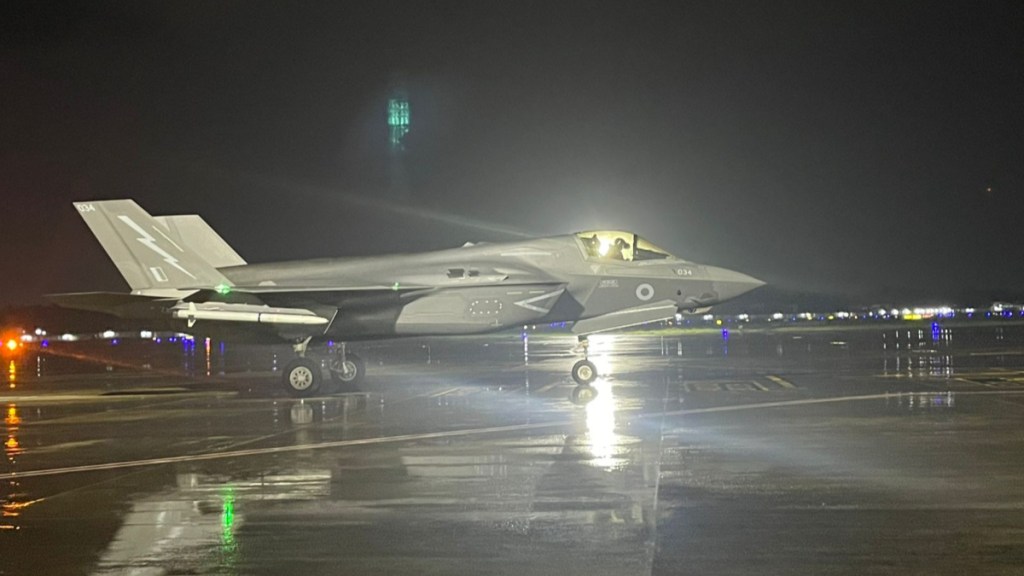
Thiruvananthapuram: The Indian Air Force (IAF) on Sunday confirmed that a British F-35B fighter jet from the Royal Navy was detected and allowed to make an emergency landing at Thiruvananthapuram International Airport on the night of June 14. The fifth-generation jet was operating from the UK’s aircraft carrier HMS Prince of Wales and was involved in routine flight operations outside India’s Air Defence Identification Zone (ADIZ) when it encountered a problem.
In a statement posted on X, the IAF said, “A Royal Navy F-35B fighter made an emergency landing at Thiruvananthapuram International Airport… After declaring an emergency and requesting diversion, the aircraft was picked up and identified by our IACCS network and given clearance to land.”
The IAF also noted that Thiruvananthapuram had already been designated as a backup landing site for such emergencies. They added that all necessary assistance is being provided to fix the issue and help the jet return to its carrier.
The incident happened shortly after the Indian Navy and the UK Carrier Strike Group (CSG25) wrapped up joint exercises in the western Arabian Sea, which featured the HMS Prince of Wales, HMS Richmond, INS Tabar, and other naval units.
Netizens are praising the IAF for detecting the fifth-generation fighter jet.
“Indian air defence system has detected UK fifth-gen fighter F-35. Tweet of Indian Air Force has aimed at multiple targets,” an X user stated.

“That’s the spirit and splendid professional ethics of the Indian Armed Forces. We are so proud of them,” a retired Indian Army officer, Col Sharad Sharan, wrote.

Meanwhile, one of the X users pointed out that the aircraft was detected as it was flying with a Luneburg lens, which allows friendly air control radars to detect them.
“F-35s fly with Luneburg lenses during peacetime to mask their real radar signature and enable friendly air traffic control radars to see them,” he said.

The F-35B Lightning II is the Short Takeoff and Vertical Landing (STOVL) variant of the F-35 stealth fighter, designed for use by the U.S. Marine Corps, Royal Navy, and other allied forces.
Features Of F-35B Lightning II Jet:
STOVL Capability
- Vertical Landing: Can land vertically like a helicopter, allowing it to operate from shorter or improvised runways and aircraft carriers without catapults.
- Short Takeoff: Requires much less runway than conventional jets.
Stealth Technology
- Low Observable Design: Shaped to evade radar detection.
- Internal Weapons Bay: Reduces radar cross-section by carrying weapons inside the fuselage.
Advanced Avionics & Sensor Fusion
- Distributed Aperture System (DAS): Provides 360° situational awareness.
- Electro-Optical Targeting System (EOTS): Integrated targeting for air-to-air and air-to-ground missions.
- Helmet-Mounted Display System (HMDS): Pilot sees flight data and targeting info directly on the helmet visor.
Networking & Data Sharing
- Multifunction Advanced Data Link (MADL): Secure, high-speed communications with other platforms.
- Sensor Fusion: Combines input from all sensors into a single, comprehensive picture for the pilot.
Weapons Compatibility
- Internal Load: Carries air-to-air missiles (e.g., AIM-120 AMRAAM), air-to-ground bombs (e.g., JDAM) internally for stealth.
- External Load: Can carry additional weapons on wing pylons in non-stealth missions.
Propulsion & Engine
- Rolls-Royce LiftSystem: Unique to F-35B for vertical lift.
- Pratt & Whitney F135 Engine: High-thrust, afterburning turbofan engine.
- Thrust Vectoring Nozzle: Redirects engine thrust downward during vertical landing.
Performance
- Max Speed: Mach 1.6 (~1,960 km/h)
- Combat Radius: ~833 km (STOVL missions)
- Ceiling: Over 50,000 feet
Operational Use
- Used on short-deck aircraft carriers, amphibious assault ships, and austere bases.
- Currently operated by the U.S. Marine Corps, UK Royal Navy, Italy, and Japan, among others.
 Defence Stories
Leave a comment